The 1% panic
Phone dies at the gate, boarding pass is a screenshot, and the only outlet has a queue.
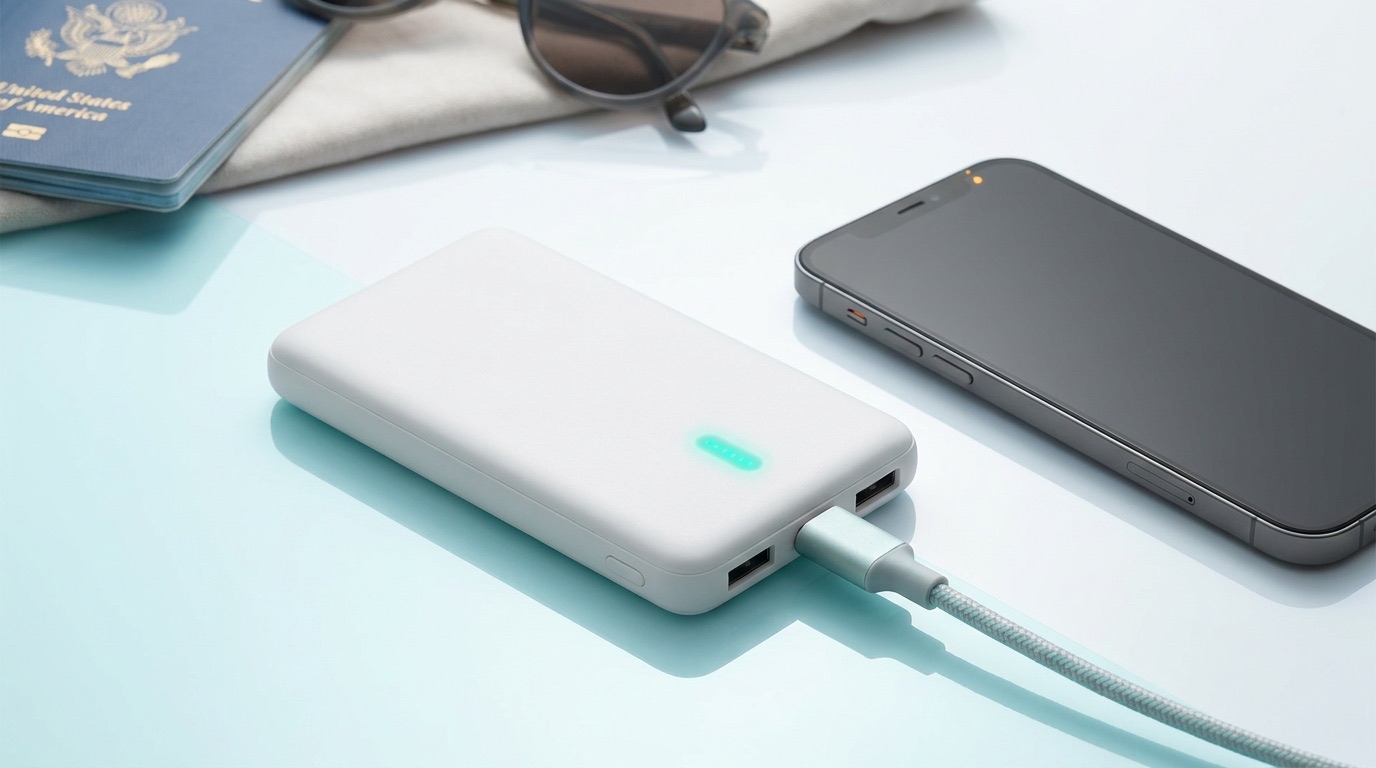
Tell us what you are charging and how long you will be unplugged. Get a recommended capacity in mAh and Wh, estimated phone charges, and a US carry-on check.
Free No email, no signup, no math. It runs in your browser.
One recommended capacity in mAh and Wh, how many phone charges that is, and a clear carry-on flag.
~74 Wh, about 3.9 phone charges
Example: one phone and a tablet, ten hours unplugged
Size a bank above, and your exact kit shows up here, step by step.
We sum a typical battery for each one: about 15 Wh a phone, 30 Wh a tablet, 55 Wh a laptop.
Every 12 hours away from an outlet, we add one full top-up, because phones and laptops do not last forever.
A bank delivers about 80% of its rated energy, so we size with 25% headroom, round up to a common bank, then check it against the 100 Wh carry-on limit.
Phone dies at the gate, boarding pass is a screenshot, and the only outlet has a queue.
Brought a tiny power bank that tops up the phone but never touches the laptop.
Packed the power bank in checked luggage, then learned at the desk that lithium has to ride with you.
Tap a trip to load it into the calculator. Real kits, sized in your browser.
FAA baseline: power banks belong in carry-on baggage with terminals protected. This calculator caps each listed recommendation below 100 Wh. International and airline rules may be stricter.
FAA baseline: keep power banks in carry-on baggage, protect terminals, and confirm the airline before flying. Banks up to 100 Wh are generally accepted. Larger batteries and international itineraries can have stricter rules.
Some 2026 international rules cap travelers at two power banks and prohibit recharging the power bank in flight; some operator guidance also says not to use one to recharge another device onboard. Check every airline and country on your itinerary.
Cables, wall chargers, and multi-port USB bricks can go in either bag, but keeping them in one carry-on pouch speeds up TSA screening of loose electronics.
At US TSA checkpoints, laptops and tablets usually come out of the bag, so keep their chargers bundled separately to grab them fast.
The 100 Wh line is about 27,000 mAh at the displayed 3.7 V conversion. Some 2026 international rules cap travelers at two power banks and prohibit recharging the power bank in flight; some operator guidance also says not to use one to recharge another device onboard. Check every airline and country on your itinerary.
Source: FAA PackSafe lithium batteries and TSA portable chargers . International reference: ICAO 2026 power-bank restrictions .
It depends on your devices and how long you are away from an outlet. One phone for a day usually needs about 10,000 mAh, a phone and a tablet about 20,000 mAh, and a laptop and a phone for a full day about 26,000 mAh. The calculator sums a typical battery for each device, adds one full top-up for roughly every 12 hours unplugged, adds 25% headroom for real-world charging loss, then rounds up to a common bank size.
FAA baseline: keep lithium power banks in carry-on baggage with terminals protected. The listed recommendations are below 100 Wh under the displayed 3.7 V conversion. Some 2026 international rules cap travelers at two power banks and prohibit recharging the power bank in flight; some operator guidance also says not to use one to recharge another device onboard. Check every airline and country on your itinerary.
About four full charges for a typical phone. A 20,000 mAh bank holds about 74 Wh and delivers roughly 59 Wh after real-world charging loss, while a typical phone battery is about 15 Wh.
Yes, if it has both the capacity and the output. The charge math is the same: a 20,000 mAh bank holds about 74 Wh and delivers roughly 59 Wh, about one full charge for a 50 to 55 Wh ultrabook. A laptop also needs a high-wattage USB-C Power Delivery port, so aim for 65W or more for a thin laptop and about 100W for a 16-inch. A low-watt bank may only slow the battery drain instead of charging it.
Yes. There is no email or account. Device and time inputs stay in this browser. Anonymous usage events are measured to improve the tool.
Upload one photo of your cable pouch and get a readiness score, an organization grade, and three quick fixes.