Ready
Pick a destination
Choose a country chip or type one in to see plug type, voltage, frequency, and packing tips.
Start here. Check and pack in two steps.
1 Check destination adapters Plug type, voltage, and whether a US traveler needs an adapter. 2 Pack a scored checklist Tick essentials, pick one bundle method, and share the result.Step 1 - Destination
Pick where you are going for the plug type, voltage, frequency, and adapter versus converter advice, straight from our built-in country table.
Ready
Choose a country chip or type one in to see plug type, voltage, frequency, and packing tips.
Step 2 - Travel cable checklist
Tick what is going in the pouch. Your packing score updates live from essentials packed, the bundling method you choose, and whether you checked your adapter. Selections stay in this browser; anonymous usage events help improve the tool.
How to organize cables for travel from the United States: group cords by how often you use them, give each bundle one reusable hold, and keep them in a single carry-on pouch. A typical US traveler kit needs a phone cable, a wall charger, a power bank, a laptop charger, and the right plug adapter for your destination. On US flights the FAA requires lithium power banks in your carry-on, never checked luggage.
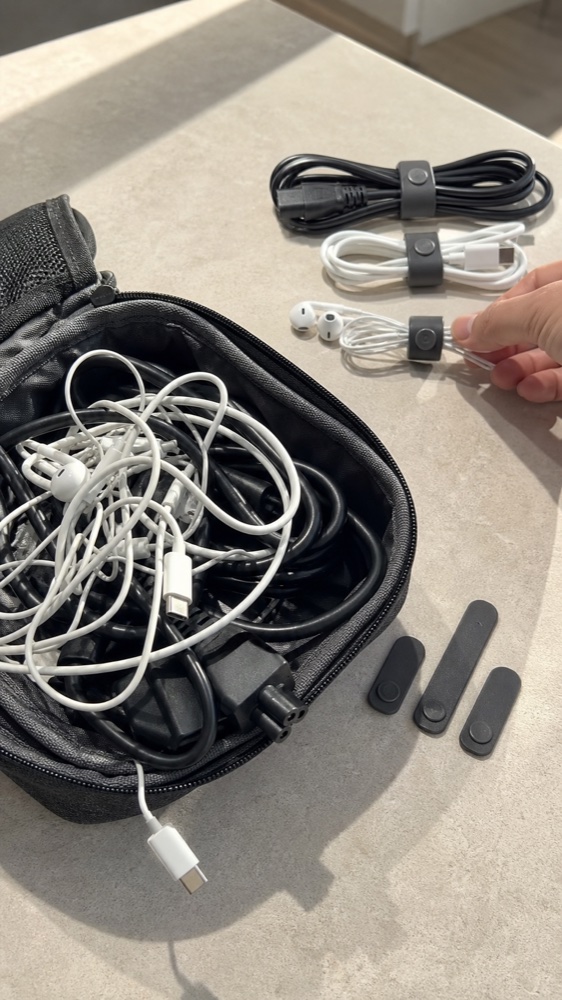
Do US travelers need a plug adapter: the United States uses Type A and B plugs at 120 V, 60 Hz, so no adapter is needed for domestic trips, Canada, Mexico, or Japan. Traveling to the UK, Europe, or Australia, match the destination socket type and check each charger label for 100-240 V. Most modern US USB chargers are dual voltage and only need a plug adapter, not a voltage converter. A reusable band such as Cloop is one tidy way to bundle each cable, alongside Velcro, pouch loops, or a freezer bag.
United States travelers
The United States runs on Type A and B plugs at 120 V, 60 Hz. That shapes which adapter you pack and how you carry batteries through a US airport. Use the quick guide below, then check your exact destination in Step 1.
| Destination | Plug | Adapter |
|---|---|---|
| Mexico | Type A, Type B | No adapter |
| Canada | Type A, Type B | No adapter |
| Japan | Type A, Type B | No adapter |
| United Kingdom | Type G | Adapter |
| France, Germany, Spain (EU) | Type C, Type E, Type F | Adapter |
| Australia | Type I | Adapter |
No adapter needed. US flat plugs fit, though some older outlets are not grounded. Pick your country in Step 1 for the full plan.
Compare options
See how reusable bands, Velcro, pouch loops, and freezer bags compare before you pick one for your trip.
Cables you open daily such as phone, charger, and earbud leads.
Costs more upfront than disposable ties, but reused trip after trip.
Thicker laptop and HDMI cords that need a wider hold.
Bulkier on small cords and can collect lint inside a bag.
Keeping a full kit upright and visible in one zip case.
Fixed slot sizes are less flexible for odd or extra cables.
Ultralight, cheap, and water-resistant grouping in a pinch.
Not durable long term and looks messy by week two.
Very light, very short cords for a single overnight.
Easy to lose and not ideal for a polished travel kit.
One toolkit, every trip
See what each step does before you start. Check the plug, scan the pouch, score the kit.
Pick your destination and get the plug type, voltage, and whether a US traveler needs an adapter or a converter, with a built-in country table that works with no key.
Check my destination →Use the separate Travel Pouch Score to estimate what is visible and get three photo-specific fixes.
Score my pouch →Tick your essentials, pick one bundling method, and watch a live packing score that is trip aware. Share it, print it, or save a branded card before you zip the bag.
Open the checklist →Free Cloop tools
Each one runs free, with no email or account. Open the one that fits your next cable task.
Match your cables to a Cloop size before you buy.
CalculatorEstimate disposable-tie waste over time.
GuidePlug type, voltage, and frequency for 20+ destinations.
DiagnosticIdentify a cable connector before you label or bundle it.
Find your fit
Tame charger and monitor cables in one pass, then take the bands on your next trip.
Keep shared chargers labeled and re-routable for hot desks and travel days.
Bundle every small cord so the pouch stays tidy and TSA-friendly.
Manage camera, drone, and thick power runs without cutting a tie.
Pick your pack
Match a reusable Cloop pack to the cables you just checked. Product links open on cloopband.com.
Why reusable
Reusable, no cuttingRe-bundle every trip. No snipping, no re-buying mid-journey.
Magnetic, fast to openOpen and close one-handed at the security tray or hotel desk.
Sized thin to thickSmall, Large, and XL cover earbud leads to laptop bricks.
Cleaner than zip ties or VelcroLess waste and a tidier pouch on every trip.
The payoff
One set of bands replaces the bag of zip ties you toss after every trip.
Take the same bands from desk to carry-on to the next destination.
Fewer loose cords means fewer tangles and faster packing.
It depends on where you are going. The United States uses Type A and B plugs at 120 V, 60 Hz, so you need no adapter for trips within the US, Canada, Mexico, or Japan. For the United Kingdom, Europe, or Australia you do need a plug adapter that matches the destination socket. Most US phone and laptop USB chargers are rated 100-240 V, so a plug adapter is enough and you rarely need a voltage converter.
Lithium power banks and spare batteries must travel in your carry-on, not checked luggage, on US flights. Keep terminals protected and each bank below 100 Wh for the baseline. Some 2026 international rules cap travelers at two and prohibit recharging the power bank in flight; some operator guidance also says not to use one to recharge another device onboard. Check every airline and country on your itinerary.
Group cords by how often you use them, give each bundle one reusable hold, and keep everything in a single pouch. Put the daily phone cable and wall charger on top, and coil the bulky laptop charger on its own so it does not tangle the small cords.
Match the destination socket type, then check each charger for 100-240 V input. Most phone and laptop USB chargers are dual voltage and only need a plug adapter. Single-voltage devices such as some hair tools may need a separate voltage converter.
The essentials are a phone charging cable, a wall charger, a power bank, a laptop charger if you bring a laptop, a destination plug adapter, and one pouch to hold them. Add camera, SD reader, and headphone cables based on your trip type.
Usually just a plug adapter. A plug adapter changes the shape of the plug so it fits the wall. A voltage converter changes the voltage and is only needed for single-voltage devices used on a different grid.
Power banks generally belong in carry-on baggage, not checked bags, with terminals protected. Keep each bank below 100 Wh for the baseline and check every airline and country on your itinerary because count, size, use, and charging rules vary.
Power-bank guidance reviewed July 2026 against FAA PackSafe and ICAO's 2026 update.
Checklist selections stay in this browser. Anonymous usage events are measured to improve the tool.